


Sherrie Sweeney Credit: Sherrie Sweeney
Sherrie Sweeney is currently in chapter three of her life having spent thirty years in telecommunications — mostly sales — before returning to school to pivot and gain certification as a Career Development Professional. She then spent almost a decade in social service and private practice.
Her time in social service was in a unique service jointly provided by Canadian Mental Health Association (CMHA) and Employment Ontario. Sherrie assisted participants facing challenges to finding competitive employment due to mental health, learning disabilities, and myriad other issues. The program was abandoned in January 2024 after the Ford government signed an outsource contract with Serco, a global, for-profit corporation.
Retired since September 2023, Sherrie is now a professional Cranky Pants and sees lots of areas of society that cause her concern and compel her to speak out.
Sherrie has been a guest on Small Change before, Sherrie Sweeney uses Maslow’s Hierarchy to explain why a Basic Income is needed NOW! detailing how a Basic Income would let folks meet basic needs like housing, food and transportation, so they’re ready and able to look for work and then, able to hold onto that job going forward.
Sherrie’s observations are based on a wealth of knowledge and experience from her time working at the Canadian Mental Health Association in their employment group as the intake co-ordinator. Sherrie explains to Small Change listeners the two pieces of the employment program, called Bridging Employment Supports and Links to Work.
Before Sherrie retired, the Ford government announced that Serco, a global, for-profit corporation, was being brought in to find efficiencies and set up a trial district. If successful, Serco would be hired to run employment services in Ontario – and, that’s exactly what happened.
According to its website powered by Serco, “EmployNext is a locally responsive, outcomes-based employment services program generously funded by the Provincial Government of Ontario’s Ministry of Labour, Immigration, Training, and Skills Development (MLITSD). We are a collaborative consortium featuring partners such as Serco Canada, Thrive Career Wellness, and Deloitte Canada, in addition to an expansive network of service providers and community partners.”
For listeners unfamiliar with Serco, it’s an international for-profit corporation based in the United Kingdom that’s responsible for prisons, detention centres as well as hospitals in Australia; prisons, defence, citizen services, transport and digital solutions in the US; and pretty much everything in Britain including public housing and their disastrous National Health Service.
In Ontario, Serco has a ten-year, $114 million contract with the Ministry of Transportation of Ontario to operate Ontario’s DriveTest driver examination centres.
Sherrie explains what happened to the folks she was helping after Serco took over Ontario’s employment services.
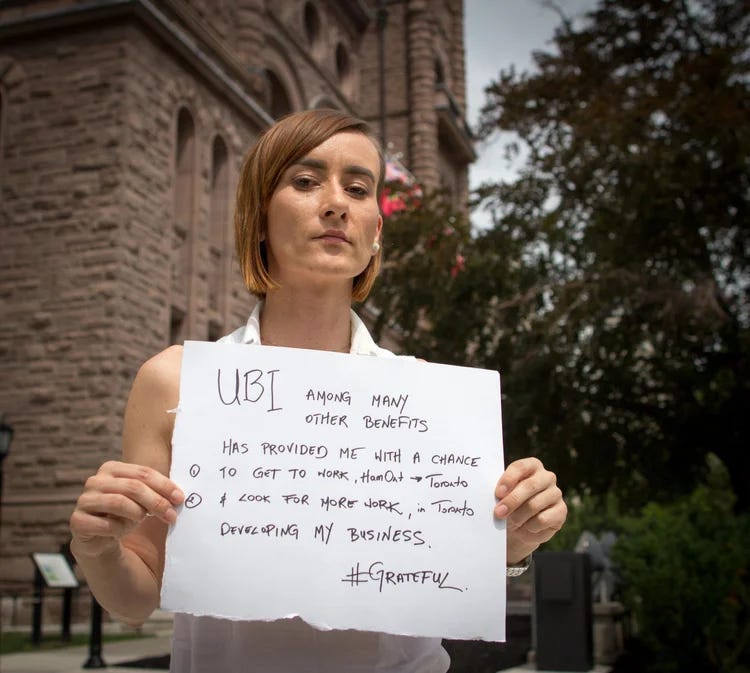
Monika Ciolek was able to develop her business, fill her pantry for the first time and give her daughter a few treats as a single mother while receiving Ontario Basic Income Pilot payments Credit: Jessie Golem — Humans of Basic Income
In March 2025, I interviewed Criminal lawyer Alison Craig, founding partner of Posner Craig Stein, about the conditions at Ontario jails. As part of that interview, I included the Ontario Ombudsman’s 2023-2024 annual report which stated in part, “In line with previous years, correctional services were the top source of complaints and inquiries in 2023-2024 – we received 4,444 cases about correctional facilities, a 26% increase from 3,524 in 2022-2023, but below the peak of 6,000 in 2019-2020.”
The report stated the most common inmate concerns continued to be medical care, overcrowding, lockdowns, segregation (solitary confinement) and the use of force by correctional officers.
During March and April 2024, a team of Ombudsman investigators conducted visits to Sudbury Jail, Maplehurst Correctional Complex in Milton, Vanier Centre for Women in Milton and Hamilton-Wentworth Detention Centre.
Here’s a summary of their findings:
At Sudbury Jail, we viewed the measures taken by the facility in response to inmate complaints about poor living conditions, and a mouse infestation in particular. We discussed the measures taken to remediate the infestation, and continue to follow up with the jail on this issue.
We received multiple complaints from inmates at the Vanier Centre for Women about severe overcrowding, not getting time out of their cells, and no access to services, including showers, due to construction projects. During our visit, staff told us the facility was dealing with a record high number of inmates. We were told staff were working to ensure inmates were given at least two hours outside their cells each day. We continue to monitor complaints about living conditions and receive updates about the construction projects.
Our visits to Maplehurst and Hamilton-Wentworth focused on speaking with senior staff about the steps being taken to address overcrowding and lockdowns. We viewed several different units in each facility, including areas we were told were overcrowded. We discussed inmate complaints about a lack of access to phones and other services, and are monitoring the facilities’ responses.
With so many cases involving the human rights of inmates every year, we are committed to remaining abreast of the latest developments and best practices in the correctional services field. We exchange information with colleagues nationally and internationally about standards for humane and effective correctional practices.
Craig described conditions where four inmates are routinely assigned to a cell intended for two. That means two inmates sleep on the floor. She also described inmates going days without being allowed to shower.
Craig and I discussed the fact that there is no “catch and release” revolving door on jails as Doug Ford claims, because if there were the jails would not be overcrowded.
The truth is, Ford has made it more difficult to get bail – something Craig claims most of these folks would qualify for. Ford also cut corrections staff adding another layer to already unbearable living conditions.
Yet, the long wait times Ford created for someone to get before a judge for either a bail hearing or their actual hearing, have made it easier for some folks to have their cases thrown out based on Jordan’s Rule limiting trial delays to 18 months for provincial courts and 30 months for superior courts.
Instead of dealing with over crowded jails and courts, Ford wants to build more jails while at the same time continuing to underfund affordable permanent housing, mental health care, effective drug treatments, and effective employment services designed to help folks who are harder to employ. In fact, providing a Basic Income would make transitioning from jail and prison not only easier, but would reduce recidivism. Seems Ford prefers paving the path to privatizing correctional services using a for-profit corporation like Serco.
Sherrie shares her thoughts on correctional services before turning the lens on the privatization of the Ontario Disability Support Program (ODSP) and Ontario Works (OW).
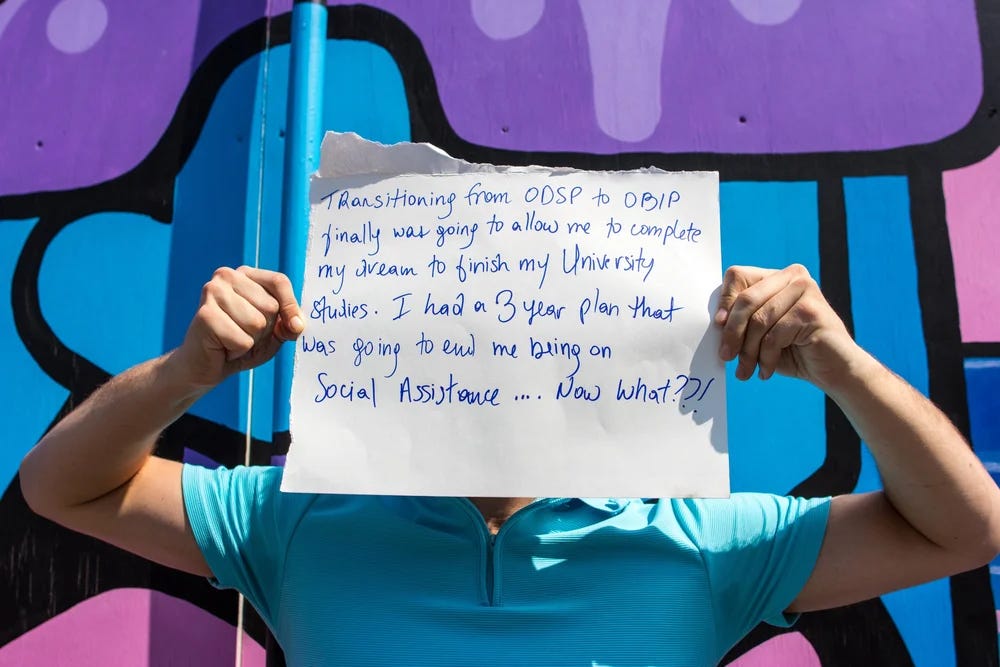
Ontario Basic Income recipient who was using the money to finish their university degree and get off of social assistance Credit: Jessie Golem — Humans of Basic Income
ODSP recipients receive $1,400 per month and OW receive $733 per month to cover rent and all living expenses. That’s $16,800 and $8,796 annually despite the poverty line for Canada being $28,000 annually.
Serco was also among the tenders considered by the Ford government when it privatized ODSP and OW services for the province. Ultimately, Maximus, a Virginia-based publicly traded, for-profit corporation was awarded the contract. Maximus’ annual revenues are in the billions of dollars. Shareholders include BlackRock, the world’s largest asset manager with $12.5 trillion in assets, that has contributed to the current Canadian housing crisis through its real estate investment trusts (REITs).
I asked Sherrie how she feels about her tax dollars going to pay a US corporation that has to make a profit so it can provide dividends to shareholders while ODSP and OW recipients live in extreme poverty.
Our conversation gravitates to the role a Guaranteed Livable Basic Income/Universal Standard of Living could play in reducing crime and recidivism; folks finding appropriate employment and being able to keep that job; and simply improving people’s overall health and wellbeing as well as that of their children.
We end today’s conversation with Sherrie answering the most important question — why don’t Canadians have a Basic Income/Guaranteed Standard of Living yet?!!!
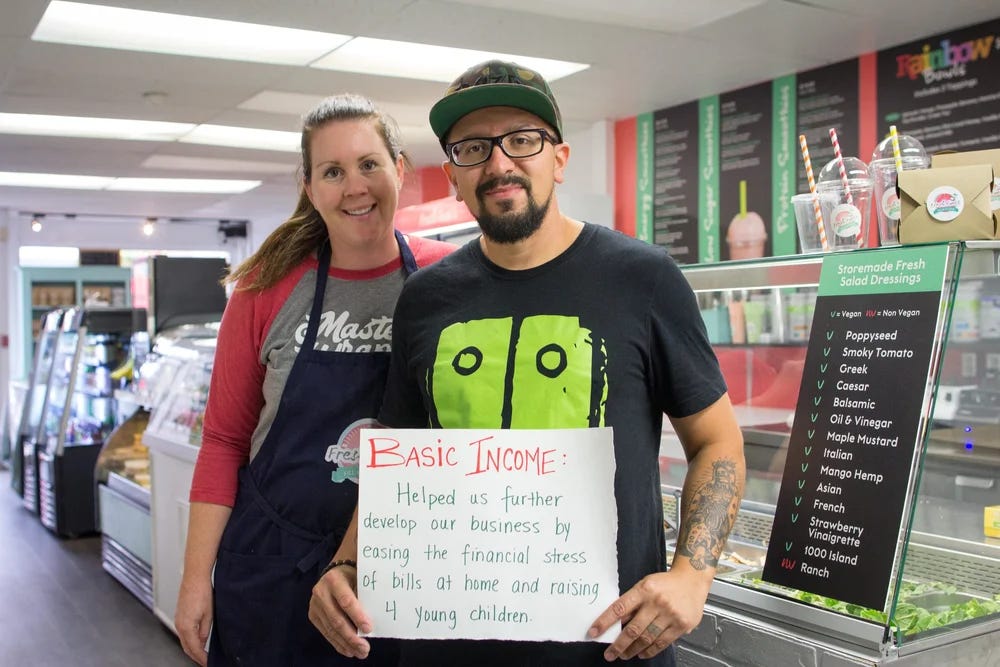
The Ontario Basic Income Pilot provided this couple with the opportunity to expand their business while supporting their four children Credit: Jessie Golem — Humans of Basic Income
Attend the 2026 Basic Income Earth Network (BIEN) Congress in Toronto, August 20 to 22 with a pre-Congress day focused on Canada on Aug.19. The world’s leaders on basic income are coming to discuss Basic Income and the Polycrisis: The Key to Unlocking the Puzzle.
Hear my previous conversation with Sherrie, Sherrie Sweeney uses Maslow’s Hierarchy to explain why a Basic Income is needed NOW! detailing how a Basic Income would let folks meet basic needs so they’re ready and able to look for work and then, able to hold onto that job going forward.
Read Basic income pilot far from forgotten, published in the Hamilton Spectator (April 13, 2026), authored by Tom Cooper, co-facilitator Ontario Basic Income Network and Director of the Hamilton Roundtable for Poverty Reduction. In his op-ed, Tom discusses how a basic income gives people the stability to not only pursue employment more effectively, but to actually improve their employment status.
Join the Hamilton Roundtable for Poverty Reduction alongside international economists, authors, doctors and other specialists in Basic Income from across the globe in a one-hour webinar, International polycrises and context for basic income, July 22, 2026 from 1 pm to 2 pm ET.
Thanks to everyone who read today’s article and listened to my podcast. With your financial support, a little Nicoll can make a lot of change.
You can also find my work in Public Parking, herizons, rabble.ca and on my Wix site. Follow me on Instagram, X @doreennicoll61, Bluesky @nicollneedschange and Facebook.
Music: Real Estate by UNIVERSFIELD is licensed under a Attribution 4.0 International License. freemusicarchive.org.
*Be sure to download the Substack app to get the most from your podcast experience.


